
The Problem Nobody Talks About
Every dually on the road is held together by studs. The wheel bolts to the hub, the studs carry the clamping force, and if you're towing 30,000 lbs on a lease road north of Grande Prairie at minus forty — those studs are the only thing between you and a wheel departure.
Here's what most people don't understand: in a lug-centric design, the studs carry the entire weight of the truck. The wheel sits on the studs, the studs sit in the hub, and every pothole, every frost heave, every loaded turn puts shear force directly on those fasteners.
That's fine for a half-ton running errands. It's not fine for a working dually pulling serious weight.
What Hub-Centric Actually Means
Hub-centric means the center bore of the wheel (or in our case, the fitment hardware) matches the hub of the truck with precision tolerances. The ring — not the studs — carries the radial load. The weight of the truck sits on the hub-centric interface, and the fasteners do what fasteners should do: hold things together, not carry weight.
Think of it like a trailer hitch. The ball carries the weight. The pin holds the coupler closed. You wouldn't ask the pin to carry the load — that's not its job. Same principle.
Why This Matters for Dually Applications
A dually rear axle is carrying more weight than any other wheel position on any consumer vehicle. The rear wheels on a loaded F-450 pulling a 30,000 lb fifth wheel can see combined loads exceeding 15,000 lbs — per side. Add in dynamic forces from rough roads, and peak loads at each wheel can spike well beyond static ratings.
In a lug-centric setup, that entire load cycles through the studs. Every bump. Every turn. Every mile. Studs fatigue. Studs stretch. Studs fail. And when a stud fails on a dually under load, the remaining studs share the deficit until they fail too. That's how wheel-off events happen.
Hub-centric load bearing eliminates this failure mode. The load goes through the hub interface — a continuous ring of machined aluminum or steel making full contact with the hub face. The studs maintain clamping force but they're not carrying weight. They don't fatigue because they're not loaded in shear.
The Gotham Forged Approach
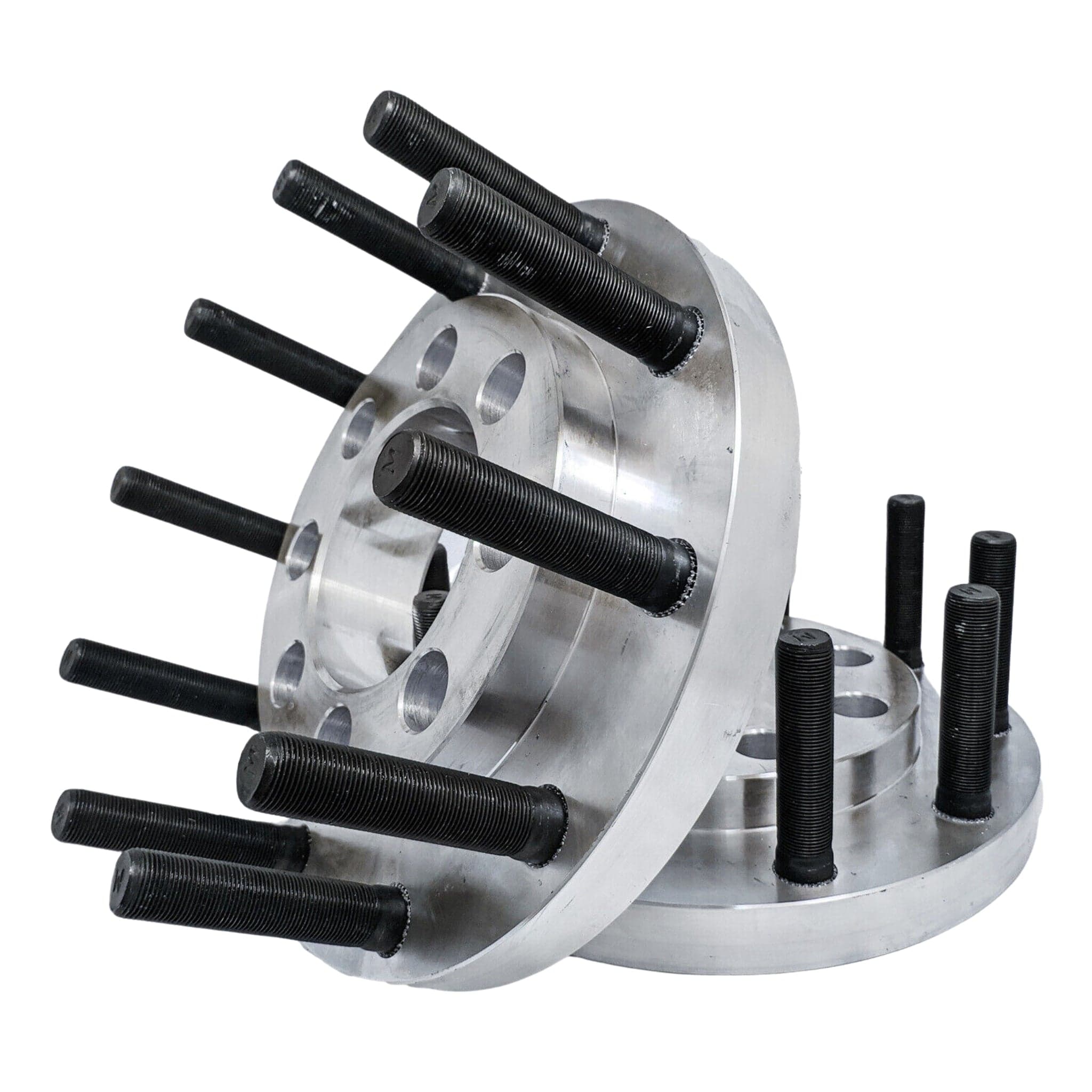
Every Gotham Forged set ships with precision-machined fitment hardware that uses a hub-centric load-bearing design on the wheel side. The hub-centric bore is machined to your truck's exact hub diameter — not a universal fit, not a set of plastic rings, but a machined aluminum interface built for your application.
On the hub side, conical seat bolts self-center the hardware onto the truck hub with a tight hub-centric bore. On the wheel side, flat seat M22 fasteners allow for controlled micro-movement under dynamic loads while the hub-centric ring carries the weight.
The result: the studs hold it on, the hub carries it. That's the engineering difference between a wheel that works and a wheel that works for 200,000 km under load.
What to Look For
If you're shopping forged dually wheels, ask one question: is the wheel hub-centric or lug-centric? If the answer is lug-centric, your studs are carrying your truck. If the answer involves plastic centering rings, you're relying on a $2 piece of plastic to center a $13,000 wheel.
Machined hub-centric. Aluminum. Precision-bored to your hub. That's the standard. Everything else is a compromise.