
Two Fastener Philosophies
In the wheel industry, there are two schools of thought on how to bolt a wheel to a hub: conical seat and flat seat. Most brands pick one and use it everywhere. We use both — in different positions, for different reasons. Here's the engineering behind it.
Conical Seat: Self-Centering Under Load
A conical seat bolt has a tapered face — typically 60 degrees — that mates with a matching taper in the mounting surface. When you torque the bolt, the cone pulls the bolt into center. The taper creates a wedging action that self-aligns the assembly.
This is ideal for the hub side of the assembly — where the fitment hardware meets the truck. You want self-centering here because the hub is the fixed reference point. The conical seat pulls the hardware into perfect alignment with the hub every time, regardless of how many times it's installed and removed.
Combined with a tight hub-centric bore (machined to your truck's exact hub diameter), the conical seat bolts ensure the assembly sits concentric to the axle. Zero runout. Zero vibration at highway speed. Zero wandering under load.
Flat Seat M22: Controlled Twist Allowance
The wheel side of the assembly is a different problem. A dually wheel under heavy towing loads doesn't just sit still — it's subjected to dynamic forces that create micro-movements between the wheel and the mounting surface. Cornering loads, braking forces, road impacts — the wheel wants to twist relative to the hub.
A conical seat in this position would fight that twist. The taper would resist movement, creating stress risers at the bolt hole perimeters. Over thousands of load cycles, that resistance leads to elongated bolt holes, cracked spoke roots, or fastener fatigue.
Flat seat M22 fasteners solve this. The flat face distributes clamping force evenly across the contact area without creating a wedge lock. When the wheel experiences dynamic loads, the flat interface allows controlled micro-movement — the bolt maintains clamping force but doesn't resist the natural flex of the assembly.
The M22 thread size provides the clamping force needed for the application. The flat seat provides the geometry that lets the assembly breathe.
Why the Hub-Centric Ring Does the Real Work
With flat seat bolts on the wheel side, what centers the wheel? Not the bolts — they clamp but don't center. The hub-centric ring does. And unlike a conical seat bolt that centers through a point contact (the taper), the hub-centric ring centers through a full circumferential contact — the entire bore of the wheel sitting on the entire diameter of the hub extension.
This is a load-bearing interface. The weight of the truck and everything it's carrying passes through this ring. The flat seat M22 bolts hold the wheel against the ring, but the ring carries the load.
This separation of duties — centering and load bearing through the hub-centric interface, clamping through the flat seat fasteners — is what allows each component to do its job without compromising the other.
The Combined System
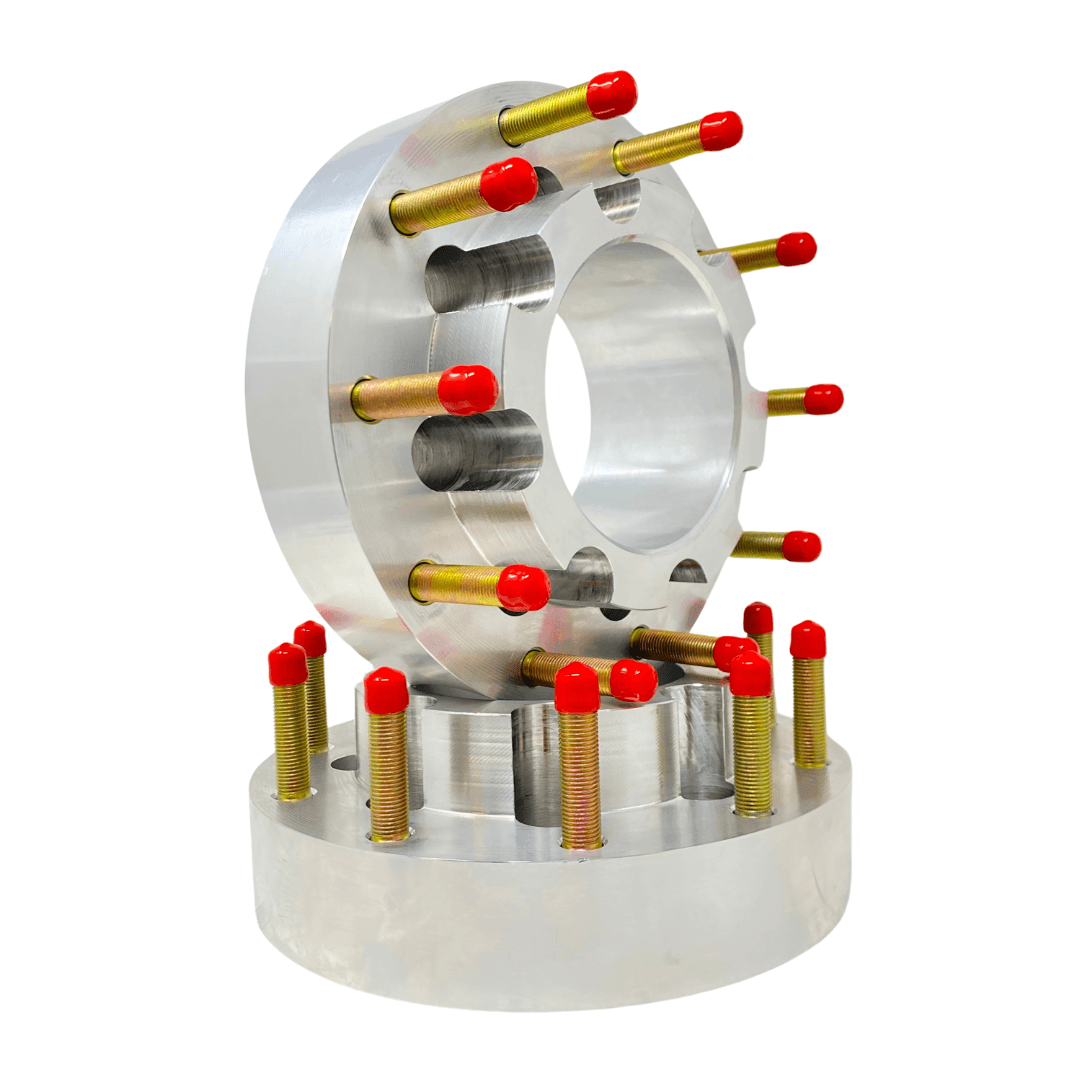
- Hub side: Conical seat bolts self-center the fitment hardware on the truck hub. Tight hub-centric bore eliminates play. This is the precision side — tight tolerances, zero movement.
- Wheel side: Flat seat M22 bolts clamp the wheel to the fitment hardware. Hub-centric ring carries the load and centers the wheel. This is the dynamic side — controlled movement, distributed load.
Two different problems. Two different solutions. One assembly that works together instead of fighting itself.
What This Means for Your Truck
If you're running a dually that tows — oilfield equipment, construction loads, RV, horses — the fastener system matters more than most people realize. A wheel that fights its own fasteners under load is a wheel that's slowly destroying itself.
The conical-and-flat system used in every Gotham Forged set is designed for trucks that work. Not trucks that sit. Trucks that pull 30,000 lbs through spring breakup and come back for more.